
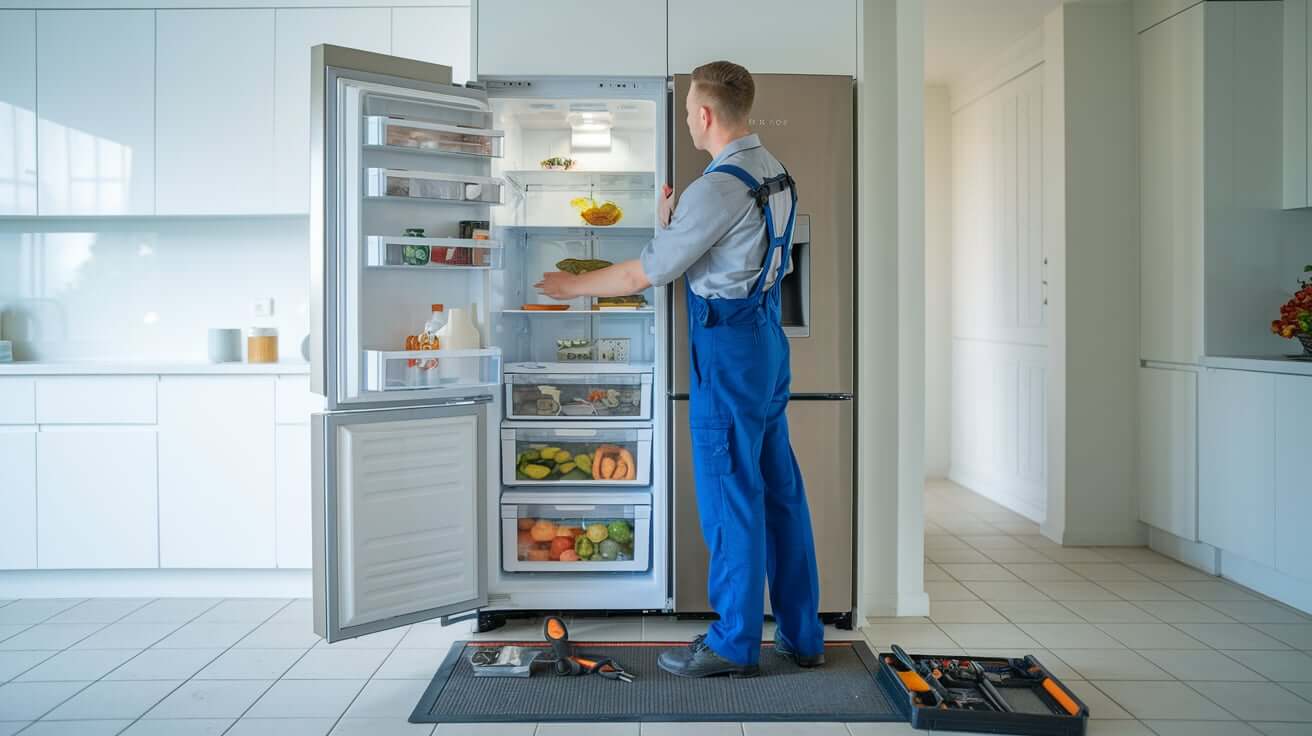
If your freezer is still cold but the fresh food section has crept above 40°F, the refrigerator is making cold air but not delivering it. That single clue narrows the problem a lot. In almost every modern frost free refrigerator, the only cold surface is the evaporator coil hidden behind the back panel of the freezer. A small fan pulls air across that coil and pushes some of it through a duct into the fresh food section. When any link in that chain breaks, the freezer stays cold because it sits right next to the coil, while the fridge side slowly warms.
This is the most common refrigerator call our technicians answer in Rochester. Below are the seven causes we find most often, in the order we check them, plus what you can safely look at yourself before you call. We also explain how a technician confirms the cause so you know what to expect from a visit.
Quick answer: why is my fridge warm when the freezer is cold?
The usual cause is a failed evaporator fan motor or an evaporator coil that has frozen solid because the automatic defrost system stopped working. Less often, a stuck air damper, blocked vents, a dirty condenser coil, a failed condenser fan or a faulty temperature control is to blame. Food safety comes first: keep the doors closed and move milk, meat and leftovers to a cooler if the fridge reads above 40°F for more than two hours.
How cold air moves inside your refrigerator
Understanding the airflow path makes the causes easy to follow. The compressor pumps refrigerant through the sealed system. Refrigerant evaporates inside the evaporator coil behind the freezer panel and absorbs heat, so the coil becomes very cold. The evaporator fan blows air across the coil into the freezer and through a duct, often with a motorized damper, into the fresh food section. Warm air returns through vents back to the coil. Several times a day, a defrost heater warms the coil for a few minutes to melt the frost that naturally forms on it, and the water drains to a pan under the refrigerator.
Because the fresh food section depends on that fan, duct and damper, any blockage or failed part shows up there first. The freezer usually stays cold for days, which is why many owners do not notice the problem until the milk turns.
The 7 most common causes
| Cause | What you notice | DIY or technician |
|---|---|---|
| Evaporator fan motor failed | No airflow from the freezer vents, no fan sound with the door switch pressed | Technician |
| Frost blocking the evaporator | Thick frost on the freezer back panel, fridge slowly warming over days | Technician (defrost system) |
| Air damper stuck closed | Freezer extra cold, fridge warm, fan running normally | Technician |
| Blocked air vents | Food packed against the vents inside the fridge or freezer | DIY |
| Dirty condenser coil | Fridge runs constantly, front grille feels warm, both sections slowly warm | DIY |
| Condenser fan failed | Compressor area hot, no fan noise under the refrigerator | Technician |
| Temperature control or thermistor fault | Display reads normal but a thermometer shows the fridge warm | Technician |
1. Evaporator fan motor
This is the number one cause we find. The fan sits behind the freezer back panel. When it stops, the freezer may still feel cold near the coil but nothing pushes air into the fresh food section. Sometimes the motor fails outright; sometimes ice builds up around the blade and stops it. A failing fan often makes a chirping or squealing noise for days or weeks before it quits.
2. Frost blocking the evaporator coil
If the defrost heater, defrost thermostat or defrost control fails, frost keeps building on the coil until air cannot pass through it. You may see a thick white layer on the freezer back panel or ice around the vents. A manual defrost restores cooling for a few days, then the frost returns. We documented exactly this in our GE refrigerator frost repair story, where the defrost heater and thermostat had both failed.
3. Air damper stuck closed
Many side by side and bottom freezer models use a damper, a small door in the air duct, to control how much cold air reaches the fridge. If it sticks closed or its motor fails, the freezer gets colder than normal while the fridge warms. Ice in the duct can also hold the damper shut.
4. Blocked vents
After a big grocery run it is easy to push a gallon of milk or a stack of containers against the vents. Air cannot circulate and the fridge warms even though every part works. This is the one cause you can fix in seconds.
5. Dirty condenser coil
The condenser releases heat from the refrigerant. When dust, lint and pet hair cover it, the refrigerator cannot shed heat, the compressor runs longer and both sections slowly warm, the fresh food section first. Coils sit under the front grille or on the back, depending on the model.
6. Condenser fan
Refrigerators with the condenser underneath use a small fan to pull air across it. If the fan stops, the compressor overheats and may cycle off on its overload protector, and cooling becomes weak and erratic.
7. Temperature control or thermistor
Electronic refrigerators use thermistors to measure temperature. A thermistor that reads wrong can tell the control the fridge is cold when it is not. The display may show the set temperature while a real thermometer shows 45°F or more.
What you can check before calling
- 1
Measure the temperature
Put a thermometer in a glass of water on the middle shelf and wait two hours. The fresh food section should read 37°F to 40°F and the freezer about 0°F.
- 2
Clear the vents
Move food away from the air vents in both sections and leave space for air to flow.
- 3
Listen for the fan
Open the freezer and press the door switch with your finger. You should hear the evaporator fan. Silence suggests a failed fan or a coil iced over.
- 4
Look for frost
A thick, even layer of frost on the freezer back panel points to a defrost failure.
- 5
Clean the condenser coil
Unplug the refrigerator and vacuum the coil under the front grille or on the back with a brush attachment.
- 6
Check the door seals
Close the door on a dollar bill. If it slides out with no resistance, warm air is getting in.
Temporary fix while you wait for a technician
If frost is the problem, a manual defrost can buy a few days. Move food to coolers, unplug the refrigerator, prop the doors open and lay towels down. A fan blowing into the freezer or a pan of hot water speeds melting. After 12 to 24 hours, plug it back in. If cooling returns but fails again within a few days, the defrost system has failed and needs repair.
How a technician diagnoses it
On a service visit we start by measuring temperatures and listening to the fans. We then remove the freezer back panel to see the coil and fan. A multimeter tells us whether the defrost heater and defrost thermostat have continuity, whether the fan motor gets voltage and whether the damper responds. Many refrigerators also have a service test mode that runs the fans, defrost and damper on command, which helps confirm the failed part quickly. Most diagnoses take under 30 minutes, and common parts like fans and defrost components are usually on the truck.
Is it worth repairing?
Fans, dampers, defrost parts and thermistors are the kind of single part repairs that make sense on most refrigerators under about 12 years old. Refrigerators last 10 to 13 years on average. If the sealed system has failed on an older unit, replacement may be the better value, and we will tell you honestly which side of that line you are on.
What we see in Rochester homes
In Rochester we see more frost related failures in late summer, when humid air enters every time the door opens, and more condenser problems in homes with pets or busy kitchens. Garage refrigerators bring their own issues in winter, covered in our garage freezer guide. If your ice maker is struggling at the same time, see why ice makers freeze up.
Still warm after these checks? Book same day refrigerator repair in Rochester and we will find the failed part.
Common questions
Can a refrigerator fix itself after defrosting?
Temporarily. Unplugging the fridge for 24 hours melts frost and restores airflow, but the frost returns within days if the defrost heater, thermostat or control has failed.
How long should a refrigerator take to cool after repair?
Most refrigerators reach 40°F within 4 to 6 hours and full temperature within 24 hours.
Is food safe if the fridge reached 45°F?
Perishable food that stayed above 40°F for more than two hours should be thrown away. Hard cheeses, butter and most condiments are usually fine.
Why is my freezer colder than normal while the fridge is warm?
A damper stuck closed sends all the cold air to the freezer. The damper or its motor usually needs replacing.